.jpg)
 English
 中文
中文 العربية
 русский
 .jpg)
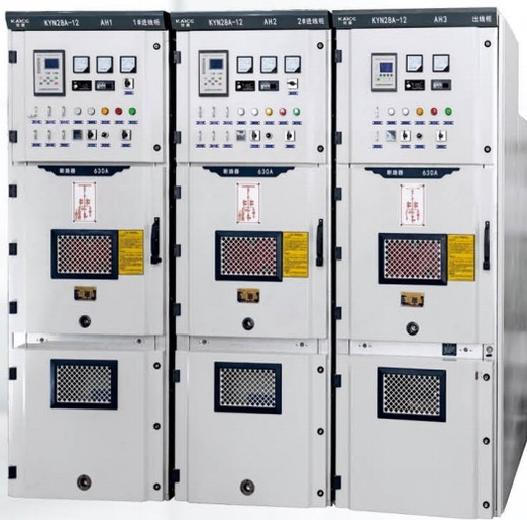
KYN28A-12 Ker loading moving type closed
Summary
KYN28A-12 is an indoor AC metal armored central switchgear. It is suitable for three-phase AC power systems with rated voltage of 12kV and rated frequency of 50Hz. It is used to receive and distribute electric energy and control, protect and monitor circuits.
meet a criterion :
GB3906-2006《3.6~40.5kV AC metal-enclosed switchgear and control equipment
GB11022-89 General Technical Conditions for High Voltage Switchgear
IEC298 (1990) "AC metal-enclosed switchgear and control equipment with rated voltage above 1kV and below 50kV"
Function and features
The switchgear is designed according to the armored metal-enclosed switchgear as specified in GB3906-91. It consists of two main parts: a cabinet and a centrally located withdrawable unit (i.e., a drawer) (see figure). The cabinet is divided into four separate compartments, with an enclosure protection rating of IP4X. When the doors of the compartments and the circuit breaker room are open, the protection rating is IP2X. It supports overhead and cable entry/exit lines, along with other functional configurations. After being arranged and combined, it forms a complete power distribution system. This switchgear can be installed, debugged, and maintained from the front, allowing for back-to-back double arrangements and wall mounting, which enhances safety, flexibility, and reduces space requirements.
◆ Shell and other
The main cabinet frame of the switchgear is made from aluminum-zinc coated thin steel plates, processed using CNC machine tools and employing multiple flanging techniques. This design ensures high precision and excellent corrosion and oxidation resistance. Additionally, the multiple flanging process makes the cabinet lighter, stronger, and more aesthetically pleasing compared to similar equipment. The cabinet features an assembled structure, connected with pull rivet nuts and high-strength bolts, which shortens the processing cycle, enhances part interchangeability, reduces space requirements, and facilitates production organization. ◆ Car The main cabinet frame of the switchgear is made from aluminum-zinc coated thin steel plates, processed using CNC machine tools and employing multiple flanging techniques. This design ensures high precision and excellent corrosion and oxidation resistance. Additionally, the multiple flanging process makes the cabinet lighter, stronger, and more aesthetically pleasing compared to similar equipment. The cabinet features an assembled structure, connected with pull rivet nuts and high-strength bolts, which shortens the processing cycle, enhances part interchangeability, reduces space requirements, and facilitates production organization.
The skeleton of the trolley is assembled by CNC machine processing of thin steel plate. The trolley is insulated from the cabinet, and the mechanism is interlocked safely, reliably and flexibly. According to the purpose, the trolley can be divided
The circuit breaker trolley, voltage transformer trolley, metering trolley, isolation trolley, and other types of trolleys are modular and interchangeable. Each type of trolley can be freely exchanged with others of the same specification. Inside the cabinet, the trolleys have positions for disconnection, testing, and operation, each equipped with a positioning device to ensure reliable interlocking. Operations must follow the interlocking error prevention procedure. The trolleys use nuts and screws for easy and flexible operation, making them ideal for on-duty personnel. When the trolley needs to be moved out of the cabinet, it can be easily removed using a dedicated transport vehicle for various inspections and maintenance. Additionally, the trolley is centrally positioned, making it compact and convenient for inspection and maintenance.
◆ traverse
The main electrical components of the switchgear are housed in separate compartments, including the circuit breaker trolley compartment, busbar compartment, cable compartment, and relay instrument compartment. Each compartment has a protection rating of IP2X; except for the relay instrument compartment, the other three compartments each have their own pressure relief channels. Due to the central placement design, the cable compartment is significantly larger, allowing the equipment to connect multiple cables.
A. Circuit breaker compartment
Tracks are installed on both sides of the isolation area, allowing the trolley 15 to slide from the open position and test position to the working position within the cabinet. The partition 13 (lively door) of the static contact box 6 is installed behind the rear wall of the trolley room. When the trolley moves from the open position and test position to the working position, the lively doors on the upper and lower static contact boxes automatically open in conjunction with the trolley. When moving in the opposite direction, the lively doors automatically close until the trolley retreats to a position that fully covers the static contact box, creating an effective isolation. Since the upper and lower lively doors can be operated separately, during maintenance, the lively door on the live side can be locked to prevent maintenance personnel from touching live parts. When the circuit breaker room door is closed, the trolley can still be operated, and through the observation window of the middle door, the open and closed positions of the trolley in the compartment and the display of energy storage status can be observed.
b. Busbar compartment
The main busbar 4 is a single unit that connects through mutual penetration. It is secured by the branch busbar 2 and the static contact box. The main busbar and the tie busbar are copper bars with a rectangular cross-section, used for high current loads, where two busbars are combined. The branch busbar is connected to the static contact box 6 and the main busbar via bolts, without additional support. For special requirements, the busbar can be covered with heat shrink tubing, connection bolts, insulation sleeves, and end caps. Adjacent cabinet busbars are fixed with sleeve 3. This connection method retains air cushion between the busbars, which can prevent internal fault arcs from melting. The sleeve 3 effectively confines the incident to this cabinet, preventing it from spreading to other cabinets.
c. Cable compartment
The switchgear is centrally located, resulting in a spacious cable room. The current transformer 7 and the grounding switch 8 are mounted on the rear wall of the compartment, while the surge arrester 10 is installed at the lower rear part of the compartment. Once the cabinet's bottom door is opened, construction personnel can enter the cabinet from below for installation and maintenance. Inside the cable room, each phase can be connected with 1 to 3 single-core cables. When necessary, up to 6 single-core cables can be connected in parallel per phase. The cabinet base, where the connecting cables are located, is equipped with a slotted, removable non-metallic or non-magnetic metal enclosure plate, ensuring easy construction.
D. Relay instrument room
◆ Pressure relief device
In the circuit breaker trolley room, busbar room, and cable room, pressure relief devices are installed above. When an internal fault arc occurs in the circuit breaker or busbar, the internal air pressure inside the switchgear increases. The special sealing ring on the door seals the front. The pressure relief metal plate at the top will automatically open to release pressure and expel gas, ensuring the safety of operators and the switchgear.
◆ Position interlock between secondary plug and trolley
The connection between the secondary wires of the switchgear and the secondary wires of the circuit breaker trolley is achieved through a manual secondary aviation plug. The moving contact of the secondary plug is connected to the circuit breaker trolley via a nylon corrugated tube, while the stationary contact seat is installed at the upper right side of the switchgear trolley compartment. The secondary plug can only be plugged in or removed when the circuit breaker trolley is in the test or open position. When the circuit breaker trolley is in the working position, the secondary plug is locked due to mechanical interlocking, preventing it from being removed.
◆ Live display device
If required by the user, an optional device for monitoring the primary circuit operation can be installed in the switchgear, known as a live display device. This device consists of a high-voltage sensor and a display unit. It not only alerts the user to the energized status of the high-voltage circuit but also works with an electromagnetic lock to forcibly lock the grounding switch handle and net door. This prevents the grounding switch from being closed while energized and stops unauthorized access to energized compartments, thereby enhancing the error prevention performance of the associated products.
◆ Prevent condensation and corrosion
In order to prevent the danger of condensation in a climate environment with high humidity or large temperature changes, heaters are installed in the circuit breaker room and cable room respectively, so as to use and prevent corrosion in the above environment.
◆ earthing device
A 5×40mm grounding copper busbar is installed in the cable room, connecting adjacent switch cabinets and ensuring good contact with the cabinet body. This grounding busbar is used for components that require direct grounding. Additionally, the entire cabinet is constructed with aluminum-zinc alloy plates, ensuring that the cabinet is in a well-grounded state, thus safeguarding the safety of operators when they touch the cabinet.
Regular service conditions
◆ Surrounding air temperature: maximum temperature +40℃. Minimum temperature-15℃
◆ Relative humidity: daily average relative humidity: less than or equal to 95%; daily average water vapor pressure does not exceed 2.2KPa; monthly average relative humidity: less than or equal to 90%; monthly average water vapor force does not exceed 1.8KPa;
◆ Altitude: below 1000m.
◆ Earthquake intensity: not more than 8 degrees.
◆ The surrounding air should not be obviously polluted by corrosive or flammable gases, water vapor, etc.
◆ No place with violent vibration.
◆ When used under normal conditions beyond GB3906, the user and the company shall negotiate.